

Tiny house for four
Here is a family following a calling to live simply and modestly. They currently live on the outskirts of Seattle, Washington, together with their two young daughters. One daughter is five years old and the other is a newborn. In their tiny home, they use a Separett Villa urine-diverting toilet all year round. Here is their story, told by the father of the family, Jake.
When my wife and I decided to move into a tiny house, it was not just about having a smaller living space, but also about environmental sustainability. We wanted to minimize unnecessary consumption and reduce the harmful impact we have on the environment. Flushing a toilet with several liters of clean water after every use felt wasteful to us.
When we sold our old house, we also encountered a problem after discovering that the septic tank had cracked. The options were either to replace the septic tank with a new one or to connect the water and sewage pipes to the municipal sewer system. Both options would have resulted in a five-figure bill. We therefore decided that in our next home, we would not have to worry about these kinds of issues.
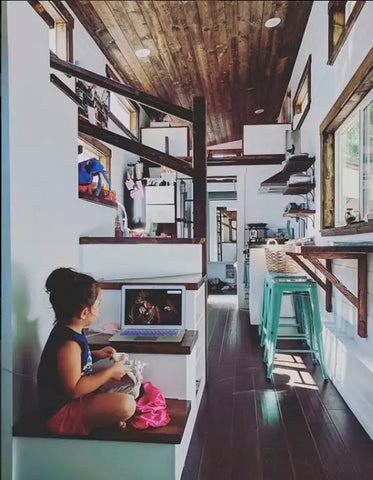
When we were planning the toilet solution for our tiny house, we came to the conclusion that a waterless toilet was the best choice. It would be an environmentally sustainable option, less wasteful, and could potentially save us a lot of money over time. We looked into the available options and examined what others had done. Considering the look of our home, I knew that the toilet needed to be as “normal” as possible and resemble a traditional flush toilet in appearance. This ruled out the more traditional DIY versions, where a hole is made in the toilet seat and a bucket is placed underneath, with bulking material added from time to time. That would not work for us, we thought.
A urine-diverting toilet seemed like the most sensible solution to us. Since we are in the United States, the brands available here are Nature’s Head and Separett. During the planning phase, we had the opportunity to test a Nature’s Head urine-diverting toilet during a two-night holiday. It worked fairly well, but we were not impressed by its appearance or ease of use. It looked more like something intended for a boat or RV. Separett’s Villa model, on the other hand, looks much more like a traditional flush toilet. The possibility of routing the urine drain pipe together with the greywater was also appealing. This model seemed best suited to our needs, and although the Villa was slightly more expensive, it has been worth it.
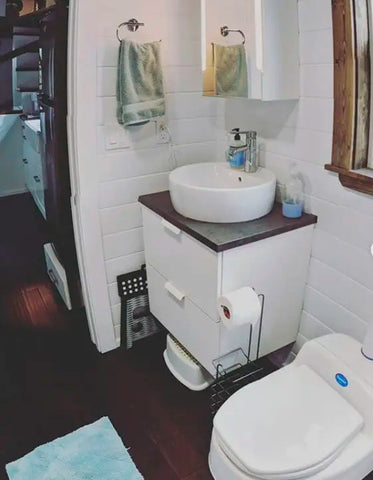
We have been using the Villa continuously since our house was completed in May 2018. We have no doubt that we made the right decision for our family. Emptying the waste container is also not as unpleasant as some might think. It is important to remember to empty the container on time, as this prevents any unpleasant toilet odour from entering the indoor space. We no longer waste perfectly drinkable water, and we have no need for a septic tank or sewer system. If I had to make the decision again, I would definitely make the same choice, knowing everything I now know about using a waterless toilet in a permanent home.
We definitely need to invest in a child seat, as our five-year-old is still struggling with positioning, and our newborn will also have to learn to use the toilet at some point.
-
At Separett, we are proud to be part of their story and their journey towards more sustainable living.
You can follow this family’s interesting life in their tiny home on
Instagram: @bigfaith_tinyspace
You can also take a tour of their tiny home on YouTube: BigFaith TinySpace